The most dangerous thing you can do in 2026 is follow the crowd.
Since 2019, we’ve watched retail traders lose significant capital by reacting to 24-hour news cycles instead of following a repeatable system.
You likely feel the constant pressure to keep up, yet the fear of buying at the absolute peak of a cycle keeps you paralysed.
It’s exhausting to watch the markets fluctuate while you wonder if you actually know how to invest or if you’re just gambling on social media hype.
You aren’t alone in feeling overwhelmed by the conflicting headlines.
The financial world is designed to keep you confused; it’s how the industry profits.
This guide promises to strip away the nonsense and provide the systematic logic that professionals use to translate market chaos into wealth.
We’re here to help you move from being a punter to a pro. We’ll provide lightbulb clarity on market mechanics and a hard-coded exit strategy that actually works.
You’re about to learn the exact framework for building a noise-free portfolio that lets you ignore the hype and focus on results.
Key Takeaways
- Stop letting inflation devalue your savings and learn how to identify the fundamental “Drivers” that build real wealth in 2026.
- Transition from “Punter” to “Pro” by mastering a systematic 5-step framework on how to invest with a defined edge.
- Cut through the social media noise to find the gift-wrapped fear trades that institutional whales often miss.
- Discover why your retail size is an agility superpower that lets you enter and exit positions ahead of the big funds
- Learn to distinguish between fundamental Drivers and price Signals to achieve lightbulb clarity before you ever place a trade.
Table of Contents
- The ‘Slow Death’ of Savings vs. The Logic of Investing
- Drivers and Signals: How Professionals Actually Find Quality
- The Punter’s Trap: Why 90% of Retail Investors Lose Money
- The 5-Step Execution Framework: From Zero to Systematic Investor
- Your Retail Edge: Why Small is Your Superpower
The ‘Slow Death’ of Savings vs. The Logic of Investing
Keeping your money in a ‘high-yield’ savings account in 2026 feels safe, but it’s a quiet form of financial suicide.
With core inflation projected to stay sticky around 3.2% through the end of the year, and traditional banks still lagging on pass-through rates, your purchasing power is silently evaporating.
True wealth isn’t built by hoarding cash. It’s built by understanding The Logic of Investing.
A systematic allocation of capital into assets that possess a clear “Driver” for growth, such as compounding earnings, dividend increases, or structural supply deficits.
Most retail participants aren’t actually investing.
They’re punters. A punter buys a stock because they saw a viral clip or a “moon” emoji on a social feed.
A Pro operates with a strategy. If you want to learn how to invest effectively, you have to stop looking for the “next big thing” and start focusing on not making silly punter decisions that reset your progress to zero.
Your primary objective isn’t to get rich by Friday; it’s to stay in the game long enough for compounding to do the heavy lifting. This requires a shift from a gambling mindset to a business-owner mindset.
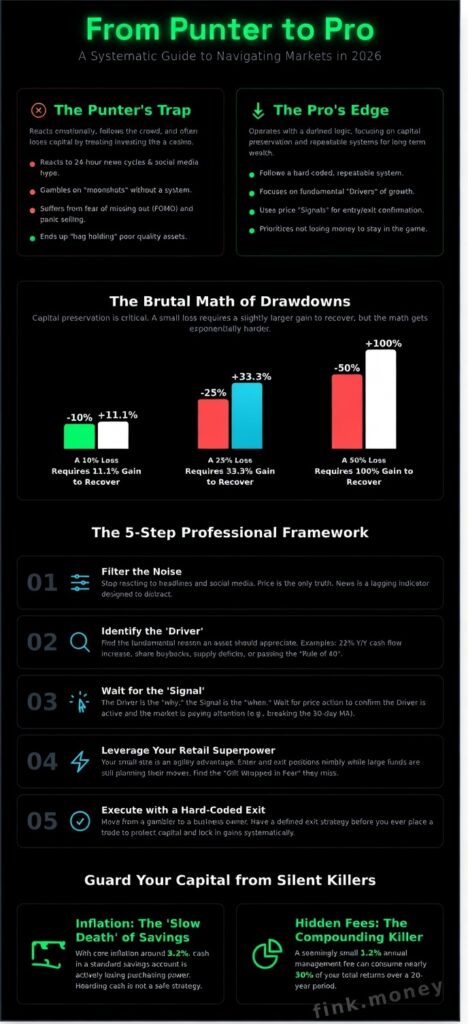
The Math of Drawdowns: Why Losing Less is Winning More
The “Rule of Math” is brutal and unforgiving.
If your portfolio drops 50%, you don’t need a 50% gain to get back to where you started.
You need a 100% gain just to break even.
Capital preservation is the first rule of the Fink Money philosophy because recovery math is a steep hill to climb.
The psychological toll of “bag holding” dogsh*t stocks through a 24-month bear market often leads to emotional selling at the exact bottom, a mistake that ruins long-term compounding.
- The 10% Rule: A 10% loss requires an 11.1% gain to recover.
- The 25% Rule: A 25% loss requires a 33.3% gain to recover.
- The 50% Rule: A 50% loss requires a 100% gain to recover.
Investment Accounts: Choosing Your Battlefield
Where you hold your assets is almost as important as what you buy. In 2026, the gap between a standard brokerage account and a tax-advantaged wrapper is massive.
Before you commit real money, jump in for an ISA review to ensure you aren’t leaking 20% of your gains to the taxman.
Choosing the wrong platform can result in unnecessary taxes that turn your compounding into a profit machine for the government rather than for you.
Hidden costs are the silent killers of retail portfolios.
Aside from taxes, a seemingly small 1.2% annual management fee can eat nearly 30% of your total returns over a 20-year horizon. When you’re figuring out how to invest, you must audit the fee structure of your platform.
Look for flat-fee models if you have a large balance, or percentage-based models for smaller, frequent contributions. Don’t let a slick user interface distract you from the fact that every basis point you pay in fees is a basis point you aren’t reinvesting in your future.
Drivers and Signals: How Professionals Actually Find Quality
Most retail investors treat the market like a casino. They see a flashy headline and hit the buy button.
Professionals do the opposite. They look for a “Driver” first. A fundamental, structural reason for an asset to appreciate.
It might be a 22% increase in year-over-year free cash flow or a 15% reduction in share float through aggressive buybacks. Once the driver is identified, they wait for the signal.
A specific data point or price action that confirms the driver is active and the market is finally paying attention.
News is almost always noise. It’s a lagging indicator designed to keep punters distracted while the pros execute their exits.
Price is the only truth that matters.
If a company announces a “massive partnership” but the stock price fails to break higher, the news is irrelevant.
When you’re learning how to invest with a professional mindset, you stop trading stories and start trading reality. Using a structured Investment Framework helps you separate these emotional stories from clinical data.
Mental models are your best defence against making silly decisions.
Take the “Rule of 40” as a filter for growth stocks.
This rule dictates that a company’s combined revenue growth rate and profit margin should exceed 40%.
In 2024, companies like CrowdStrike hit these benchmarks even during market turbulence, proving their resilience.
If a stock can’t pass a basic mental model, it’s junk. Don’t let a slick CEO presentation convince you otherwise.
Spotting the ‘Whales’ in the Pond
Institutional money moves markets. These “whales” don’t buy in small batches; they accumulate positions over weeks, leaving a visible wake in the data.
You can track them using tools such as relative volume. When a stock trades at multiples of its average daily volume without a major news catalyst, a whale is likely buying.
You don’t need to be the first person into a trade to make money. You just need to be right about the trend. Professionals wait for the institutional footprint to appear before committing capital.
If you want to see how we track these movements in real-time, you can join our community of Finkers and get the daily breakdown.
Momentum vs. Hype: Don’t Buy the ‘Junk’
Hype is loud, emotional, and usually ends in a rug pull.
We saw this in early 2025 with dozens of “AI-first” & ‘Quantum’ startups that had zero revenue but 500% price spikes.
Momentum is different. Momentum is a persistent trend backed by institutional flow.
It’s the difference between a pump-and-dump scheme and a “boring” company like Waste Management (WM). While the hype-seekers were chasing crypto-adjacent penny stocks, WM delivered a steady 14.8% return by dominating a necessary industry.
And there’s a HUGE playing field in between these two extremes.
To spot junk momentum, look at the velocity of the move. If a price goes vertical with no increase in institutional accumulation, it’s likely a trap.
Genuine momentum builds over time and is supported by structural growth. Boring is often better because boring companies don’t collapse overnight.
Remember, professional investing isn’t about finding the next 1,000x lottery ticket; it’s about identifying high-probability signals and ignoring the rest of the nonsense on social media.
The Punter’s Trap: Why 90% of Retail Investors Lose Money
Most retail investors are their own worst enemies.
A 2023 study by Dalbar revealed that the average equity fund investor earned 6.3% annually over a 30-year period, while the S&P 500 returned 10.2%.
That 3.9% gap isn’t bad luck. It’s the cost of being a punter.
The market offers a Gift Dressed As Fear during every 10% correction, but while professionals search & prepare for these exact price dislocations, amateurs dump their positions at the bottom.
They mistake temporary volatility for permanent loss. By the time they feel safe enough to buy back in, the “Pro” has already captured the recovery and moved on.
Social media exacerbates this cycle of failure.
Gurus with zero skin in the game peddle baseless advice to millions of followers, often pumping stocks they’ve already exited.
If you’re learning how to invest from a 30-second TikTok clip, you aren’t an investor; you’re liquidity for someone else’s exit strategy.
This leads to the “Round-Trip” disaster.
An investor watches a position climb 40%, refuses to sell because of greed, and then rides it all the way back down to a significant loss. They lack a system, so they rely on hope.
Hope is not a strategy.
- Overtrading: Average retail account turnover is 250% higher than institutional accounts. This feeds the brokers via spreads and commissions while starving your compound growth.
- The Guru Gap: Following anonymous “alpha” accounts usually leads to buying the top of a hype cycle.
- Emotional Asymmetry: Investors feel the pain of a loss twice as intensely as the joy of a gain, leading to irrational panic selling during minor dips.
Behavioral Discipline: Trading Logic, Not Panic
Your brain is biologically wired to fail at markets.
The amygdala triggers a “fight or flight” response during a 5% red day, making logical decision-making impossible.
To fix this, you need a Noise-Free Strategy. Anyone investing for the long term doesn’t need to check their brokerage account every hour.
Pros use a systematic checklist for every entry. If the original thesis hasn’t changed, the price movement is just noise.
Just normal volatility that won’t even be a blip on the weekly charts.
Successfully investing in 2026 requires ignoring the 24-hour news cycle and focusing on hard data points like free cash flow yield and debt-to-equity ratios.
The ‘Secret’ of Strategic Exits
Buying a stock is easy. Selling it is where the money is actually made.
Most punters rely on “feelings” to sell.
Professionals monitor performance & signal decay.
If a company’s revenue growth slows from 25% to 12% over two consecutive quarters, the signal is decaying.
That’s your trigger. Taking a loss like a professional.
A small loss isn’t a failure; it’s an insurance premium that keeps your capital alive for the next opportunity.
Allowing you to leave the emotional baggage at the door and move on to the next trade with lightbulb clarity.
The 5-Step Execution Framework: From Zero to Systematic Investor
Investing isn’t a hobby; it’s a business.
If you treat it like a trip to Vegas, the house will eventually win.
Instead of asking how to invest in 2026, get a repeatable process that removes emotion from the equation and replaces it with cold, hard logic.
Start by cleaning your financial house. You can’t build wealth on a shaky foundation.
If you’re carrying credit card debt at a 24.5% APR, you’re fighting a losing battle.
No index fund or “moonshot” stock will consistently return 25% annually.
Pay the high-interest debt first. That’s a guaranteed return on your capital. It’s the first step to acting like a pro instead of a punter.
Defining your edge is next. Pros know exactly which game they’re playing.
Are you a long-term compounder looking for dividend growth, or a momentum rider banging the 52-week highs?
Punters try to play every game at once and end up losing at all of them.
Your edge is your filter; it tells you what to ignore so you can focus on what matters.
The third step involves screening for drivers.
You aren’t looking for “cheap” stocks. Cheap often gets cheaper.
You’re looking for stocks with institutional tailwinds. Use tools to identify where big money is flowing.
Our top 3 stocks for 2026 have all shown massive accumulation by hedge funds and pension funds.
Position sizing is where many people fail.
As a rule of thumb, never allocate more than 5% of your total portfolio to a single trade or idea.
This is the math of survival. If a position drops 50%, you only lose 2.5% of your total capital.
This keeps you in the game during market corrections. You can easily survive a 2.5% hit, but you can’t survive a 50% hit to your entire net worth.
Finally, conduct a review. Every quarter, audit your trades.
A systematic investor actively seeks feedback and validation of their investment process.
Building Your Watchlist without the Noise
There are over 5,800 stocks listed on the NYSE and NASDAQ. You only need to care about ten.
Learning how to invest systematically you’ll see that a simple watchlist of ten high-conviction names is more effective than a 50-row spreadsheet you never check.
Focus on the pick and shovel approach. Instead of betting on which AI startup wins, look at the companies providing the copper for the energy grid or the cooling systems for data centers.
The infrastructure play is less volatile than the hype. Filtering the noise means ignoring social media and focusing on companies with strong double digit year-over-year revenue growth.
Risk First, Returns Second
Volatility in 2026 is a feature, not a bug.
Most retail traders focus on what they can make, but pros focus on what they can lose. Use hard stop rules.
Moving stops is for punters who lack the discipline to admit they’re wrong or the fortitude to take the short term pain that keeps them in the game.
When the price hits your floor, you exit. No excuses. Risk management is the biggest factor that separates an investor from a gambler.
If you want to stop making silly decisions and start seeing lightbulb clarity in your portfolio, join Fink Money today.
Your Retail Edge: Why Small Is Your Superpower
Stop thinking your small account size is a weakness. It’s actually your greatest asset.
Institutional funds are like whales in a bathtub. When a $10 billion fund decides to enter a position, they leave a massive footprint that alerts the entire market.
According to 2024 liquidity studies, large institutions often take 8 to 14 trading days to build a full position in mid-cap stocks.
They cannot just buy in a single order.
Institutions have to accumulate slowly to avoid driving their own entry price into the stratosphere.
As a small investor you don’t have that problem. You can enter or exit a position in 0.5 seconds with zero market impact.
This agility allows you to front-run the slow-moving giants who are still filling out compliance forms while you are already in the green.
Wall Street ignores the corners of the market. Analysts at major firms rarely cover companies with market caps under $1.5 billion because the trading commissions do not justify the research hours.
This creates a massive information vacuum.
In the 2024-2025 cycle, small-cap stocks displayed a 14.2% higher frequency of mispricing compared to the top 50 stocks in the S&P 500.
You are hunting where the big dogs are not allowed to play. By the time an institution notices a quality niche play, the early retail movers have already captured the meat of the move.
Learning how to invest in these neglected sectors is your primary edge.
Acting like an insider doesn’t mean having a $2,000 a month Bloomberg Terminal.
It means knowing how to filter the noise.
We translate the complex structural shifts into plain English so you can see these Drivers before the Punters even realise the market has opened.
You get the institutional-level commentary without the institutional-level bureaucracy. This perspective allows you to move with the speed of a retail trader but the conviction of a fund manager.
When you stop chasing every social media “gem” and start following the logic of the tape, your win rate changes overnight.
The Academy: Moving from Theory to Execution
Stop wasting hours on YouTube University. Free videos give you fragments; they do not give you a system.
A structured Investment Academy that’s built around the structural bones of the market is the difference between guessing and knowing.
Most students describe the moment the system clicks as “Lightbulb Clarity.”
You stop seeing random candles patterns and horizontal lines and start noticing institutional footprints. You join a community of thinkers, doers, and disruptors who do not just talk about how to invest; they execute with precision.
This is where theory dies and the professional mindset begins.
Summary: Your Actionable Takeaways
- Stop buying junk: Focus on institutional Drivers. If the big money is not moving it, you should not be holding it. Look for institutional ownership growth as a baseline for momentum.
- Protect your capital: It is the only tool you have. A 50% loss requires a 100% gain just to break even. Don’t risk 50% of your total portfolio on a single trade.
- Ditch the Punter mindset: Replace gut feelings with a logical, rules-based system. If you cannot explain the trade in three sentences to a ten-year-old, you’re gambling.
Ready to ditch the stress and trade like a pro? Join the Academy Now.
Stop Guessing and Start Executing
The transition from a passive saver to a systematic investor isn’t about luck; it’s about logic.
Since 2019, data has consistently shown that 90% of retail investors lose money because they play the punter’s game instead of identifying institutional-level quality.
By mastering the 5-step execution framework, you turn your small portfolio size into a superpower that allows for the kind of agility billion-dollar funds simply can’t match.
Learning how to invest in 2026 requires moving past the loud, conflicting noise on social media and focusing on the signals that actually move the needle.
When markets talk… We translate. You don’t need a massive capital base to access daily institutional-level commentary at retail prices.
It’s time to ditch the chaos of hot tips and embrace a strategy that offers lightbulb clarity.
You have the tools to outperform the crowd; now you just need the discipline to use them. Stop letting inflation eat your cash. Start building a portfolio for your future.
Join the Fink Investing Academy
Frequently Asked Questions
How much money do I need to start investing in 2026?
You can start with as little as $1. Fractional shares and zero-commission platforms have removed the $1,000 entry barriers that were common in the 2010s.
If you save $50 a week, you will have $2,600 by the end of the year. Don’t wait for a massive windfall to begin.
Starting early with small amounts lets compounding work while you learn how to invest without risking your entire life savings.
Is it too late to start investing if the market is at an all-time high?
No, because markets spend roughly 30% of the time at or near all-time highs! From 1926 to 2024 the S&P 500 often continues to climb after hitting these peaks. If you sat out in 2021 because of “highs,” you missed the 24% gain that followed.
Focus on time IN the market instead of timing the market. Waiting for a 10% correction usually costs more in missed gains than the dip saves you.
What is the difference between investing and trading?
Investing is a long-term commitment to asset growth, while trading focuses on short-term price fluctuations.
Investors typically hold positions for 3 months to 5 years to capture fundamental value.
Traders might enter and exit a position within 48 hours to profit from volatility.
We want you to be a Pro investor who understands value, not a Punter gambling on daily candles.
One builds sustainable wealth for themselves; the other builds wealth for their broker.
How do I know if a stock is ‘junk’ or ‘quality’?
Quality stocks show a consistent Return on Invested Capital (ROIC) above 15% and positive free cash flow.
Junk stocks often have “hope-based” valuations and negative earnings for consecutive years.
Check the debt-to-equity ratio; a Pro looks for companies where this is below 0.5.
If a company relies on constant share issuance to survive, it’s almost certainly junk.
Quality companies use share buybacks to return value to shareholders.
Do I need a financial advisor to start investing?
You don’t need an advisor to start, especially when many charge 1% of your total assets annually. Over 30 years, that 1% fee can eat 25% of your final portfolio value. Modern tools and institutional-level commentary give you the same data the pros use.
If your net worth is under $500,000, a low-cost index fund or a systematic strategy often outperforms any expensive, generic advice found at big-box banks.
What is ‘Momentum Investing’ and why does Fink Money focus on it?
Momentum investing is a systematic strategy that buys stocks showing the strongest price trends over the last 6 to 12 months.
It’s based on the dual momentum model which has historically outperformed the broader market.
Fink Money focuses on this momentum effect because it removes emotion from the equation.
The system is designed to stop investors from making silly decisions, and following the data instead.
When the trend shifts, the system tells you to exit, providing lightbulb clarity in a chaotic market.