In markets, the single most valuable filter you can apply to any thesis, any chart, or any panic-driven headline is one deceptively simple question: does this make sense?
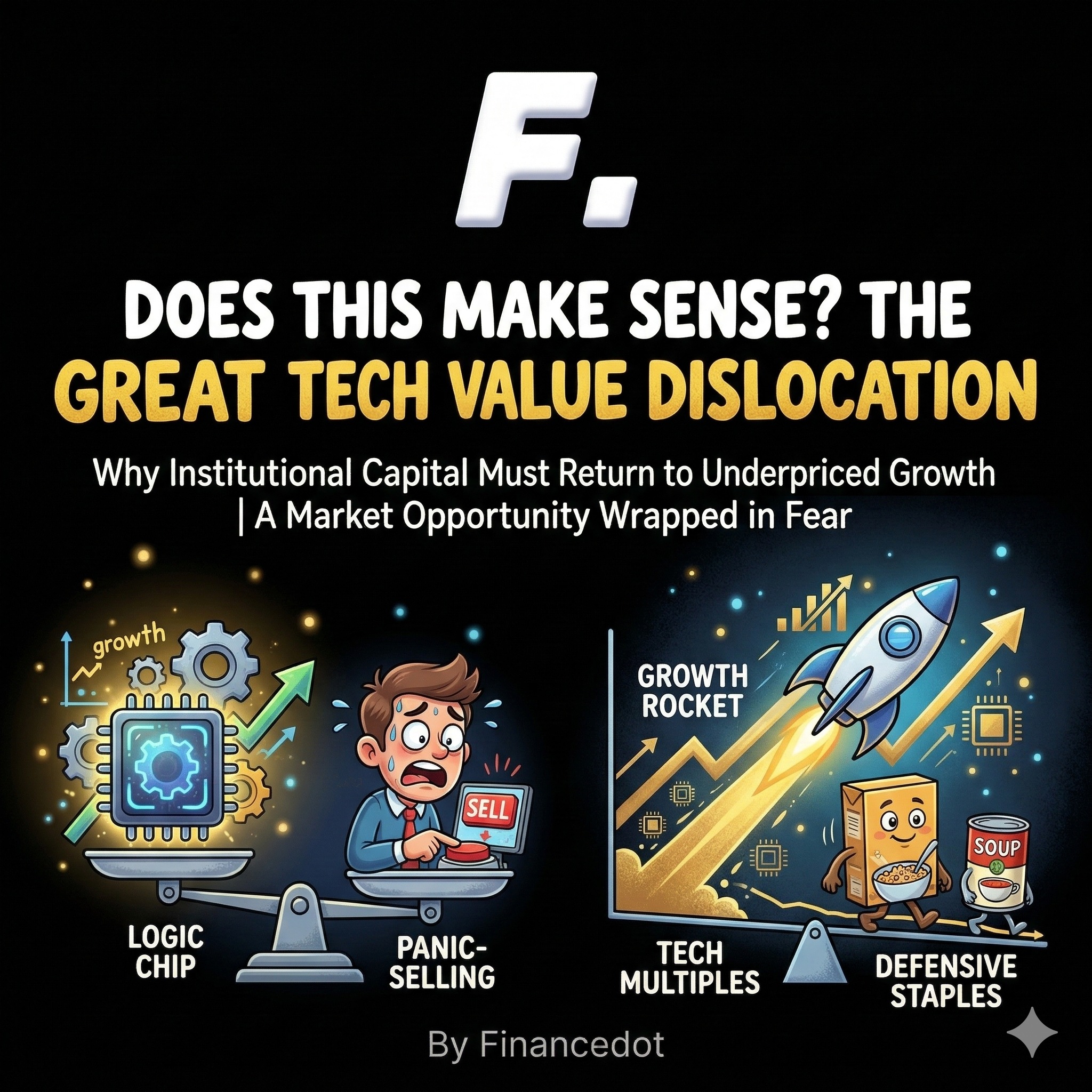
Right now, we are looking at a market environment where consumer staples are trading at a higher forward price-to-earnings multiple than the technology sector.
So… does this make sense?
Absolutely not. It defies the basic laws of market physics.
The market is currently paying a higher premium for the future earnings of companies that sell toothpaste, toilet paper, and canned soup than it is for the companies building the cloud infrastructure, artificial intelligence, and software that quite literally run and will continue to run, the modern global economy.
Tech, as a sector, is fundamentally composed of growth stocks. These are businesses with massive operating leverage, many with strong moats and the ability to scale globally with near-zero marginal costs. Consumer staples, on the other hand, are defensive plays. They are low-margin, slow-growth, highly mature businesses that investors crowd into when they are terrified of the future.
There’s been a lot of fear surrounding SaaS stocks of late, but many keep seemingly excluding the distribution, marketing and execution side of running a successful business.
You cannot simply AI your distribution and execution. It requires a serious amount of luck, perseverance and stress that doesn’t match up when you consider the apparent ease that vibecoding an app seems to be providing…
Growth stocks will always command a higher multiple than consumer staples on any timeframe longer than a single financial quarter. Always. If you are investing for a year, three years, or a decade, you pay for earnings expansion, not just dividend preservation.
So, what we are witnessing right now is not a new normal.
It is a dislocation. It is a temporary psychological shift driven by fear, and it has created a scenario where tech is, in my opinion, supremely undervalued. The rubber band has been stretched too far in the wrong direction, and the snapback is going to be violent.
A few points to note on the larger-cap tech names will drive this view much harder. Let’s look at the absolute titans of the space.
Take Microsoft (MSFT). We are currently watching one of the most dominant, cash-printing machines in human history trading right at its 200-week moving average. But the technicals are only half the story. The truly staggering part is the valuation. Microsoft is currently trading at the exact same multiple it traded at during the absolute depths of the 2020 Covid bottom.
Think about that for a second. In March 2020, the global economy was literally shutting down. Supply chains were freezing, no one knew if businesses would survive the month, and fear was at an all-time high. Today, Microsoft is the undisputed leader in enterprise AI integration, their Azure cloud business continues to gain market share (even if their CoPilot is a bit shit) and they have pricing power that defensive companies could only dream of. Yet, the market is pricing MSFT as if the world is ending.
Does this make sense? Not even slightly.
Then there is Nvidia (NVDA). The undisputed king of the hardware revolution. The stock is currently almost touching its 200-day moving average. Why? Did their business model break? Did demand dry up? No. They just posted another record-shattering quarter. They blew past estimates, guided higher, and reiterated that the demand for their next-generation chips far outstrips their ability to supply them. The fundamentals are screaming hyper-growth yet the price action is acting like a tired, bored utility.
Again… does this make sense?
When you see a disconnect of this magnitude between fundamental reality and price action, you have to look at the mechanics of the market to understand how it resolves.
Ask yourself: where does real money HAVE to deploy to get the most efficiency?
When I say real money, I’m not talking about retail traders on an app. I’m talking about sovereign wealth funds, massive pension funds, and institutional asset managers who need to move billions of dollars to generate returns. When the fear subsides and these entities realise they are deeply underweight the only sector actually generating structural earnings growth, where do they go?
They can’t hide in mid-cap consumer defensive stocks. The liquidity simply isn’t there. If a major fund tries to deploy $5 billion into a cereal company, they will move the price so violently against themselves that the trade becomes entirely inefficient.
They have to go to the stocks that are the most liquid, with the largest market caps. They have to buy the Magnificent 7. They have to buy Microsoft, Apple, Google, and Nvidia. These mega-caps are the only vehicles on the planet deep enough to absorb that kind of institutional capital without causing massive slippage.
In my view, the coming weeks are going to see a fierce, undeniable rebalance back into these larger-cap tech stocks. The rotation out of tech has exhausted itself, and what we are about to witness is forced buying. Institutions cannot afford to underperform their benchmarks heading into the end of the year, and you cannot beat the benchmark by hiding in expensive, low-growth consumer staples.
Finally, we have to address the geopolitical noise, specifically the recent headlines regarding Iran strikes and Middle East escalations. The media wants you to believe this is a reason to sell. I fundamentally disagree.
These events are not a structural risk to the earnings power of mega-cap tech. A missile strike does not stop a Fortune 500 company from migrating to the cloud. It doesn’t stop the arms race in artificial intelligence. What these geopolitical events do is create a localised panic – a spike in the VIX, a rush for the exits by weak hands, and a temporary mispricing of assets.
Let’s be honest about who is actually seling too. People dumping high-quality tech stocks based on short-term geopolitical headlines are operating entirely on emotion. And when emotion takes the wheel, logic goes completely out the window. They are panic-selling based on an unpredictable geopolitical future they have absolutely zero knowledge of, nor any control over.
Conversely, when you look at a dominant business and understand it is fundamentally positioned to make significantly more money in the future, you are operating on cold, hard logic. You aren’t guessing what a foreign military might do tomorrow; you are relying on compounding growth and earnings power. When you use logic, you don’t fear the emotional seller, you thank them. You use their panic-induced lower prices to secure an even better entry point on a world-class asset.
In other words, the Iran strikes are not a risk right now… they are an opportunity. They are a clear event where an artificial risk premium has been baked into the price of the world’s best companies, and that premium is sitting there waiting to be exploited by anyone clear-headed enough to take the other side of the trade.
The market has handed us a gift wrapped in fear. Consumer staples are overpriced. Tech is deeply, fundamentally underpriced. The biggest pools of capital in the world are going to have to correct this imbalance soon.
Look at the board. Look at the multiples. Ask yourself if this makes sense.
When you realise it doesn’t, you know exactly what to do.