
The stock market feels overwhelming because it’s designed to. It’s a world filled with jargon, conflicting advice from social media ‘gurus’, and a constant, nagging fear of making a ‘silly decision’ with your hard-earned money. This noise stops most people before they even start. If you’re tired of the hype and just want a straight answer on how to invest in stocks, you’ve found it. We exist to stop investors from making those exact mistakes.
This is not another dense, theoretical guide. This is your actionable blueprint. We are going to cut through the chaos and give you a clear, step-by-step plan to make your first investment with confidence. By the end of this article, you will have the ‘lightbulb clarity’ needed to understand how the market actually works, know precisely what to do next, and feel ready to start building your wealth like a Pro, not a Punter. The markets are talking. We’re here to translate.
Key Takeaways
- Adopt a professional investor’s mindset. True wealth is built by owning pieces of great businesses, not by gambling on market noise.
- Discover our 5-step blueprint that shows you exactly how to invest in stocks, moving you from a confused beginner to a confident investor.
- Learn a simple framework to research stocks effectively and filter out the dangerous hype you see on social media.
- Identify the top 4 beginner mistakes that can destroy your portfolio. Avoiding these common traps is the fastest way to protect your capital.
Table of Contents
- Before You Buy a Single Stock: The Mindset of a Pro
- Decoding the Market: What You’re Actually Buying
- The 5-Step Blueprint to Making Your First Investment
- How to Research Stocks (And Filter Out the Noise)
- Top 4 Beginner Mistakes That Cost Investors Dearly
Before You Buy a Single Stock: The Mindset of a Pro
Welcome to the starting line. Most people eager to learn how to invest in stocks jump straight to picking tickers. That’s the Punter’s game-a fast track to making silly decisions. We’re here to build Pros.
A Pro understands that buying a stock isn’t like placing a bet. It’s buying a fractional share of a real business. But before you can analyse a company, you have to understand the arena. A foundational grasp of what the stock market is isn’t just academic; it’s your first strategic advantage. This section covers the critical prep work. Skip it at your peril.
Rule #1: Define Your Financial Goals
First, answer this…
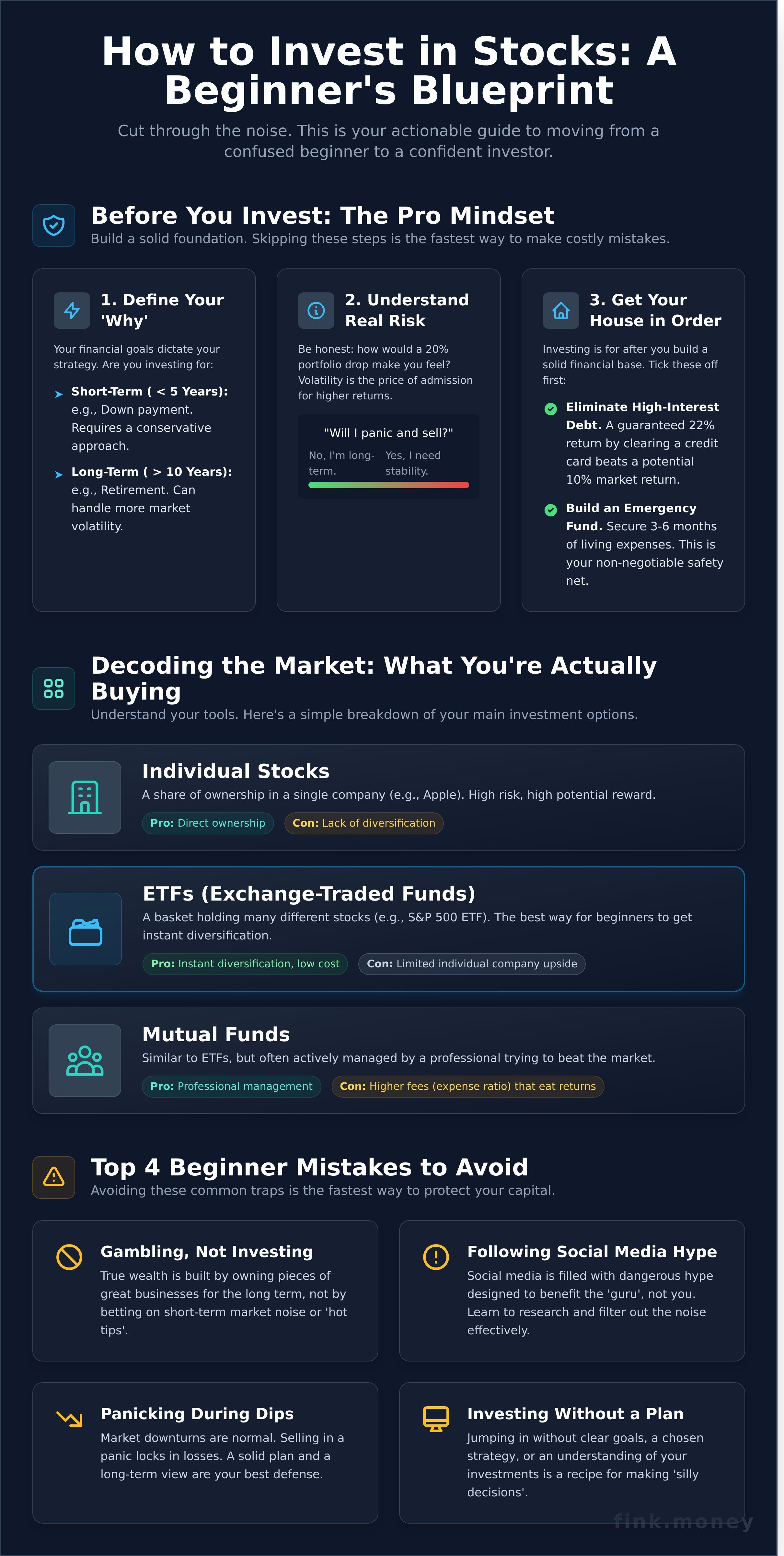
Why are you investing? Is it for a down payment in three years? Retirement in thirty? Financial freedom in ten? Your timeline is everything. Short-term goals (under 5 years) demand a vastly different, more conservative strategy than long-term goals. Your ‘why’ dictates your ‘how’. Get this clear before you do anything else.
Rule #2: Understand Your Real Risk Tolerance
How would you feel if your portfolio dropped 20% in a month? If the answer is “panic and sell everything,” you need to know that now, not later. Volatility is the price of admission for market returns. Understanding your real comfort level isn’t about being brave; it’s about being honest so you can build a portfolio that lets you sleep at night.
Rule #3: Get Your Financial House in Order
Investing is what you do after you’ve built a solid financial base. Trying to out-earn high-interest debt with market returns is a losing game. It’s like trying to fill a bucket with a hole in it. Before you invest a single dollar, you must:
- Eliminate High-Interest Debt: Pay off those credit cards. A guaranteed 22% return by clearing a credit card balance beats a potential 10% market return every single time.
- Build an Emergency Fund: Secure 3-6 months of essential living expenses in a savings account. This is your non-negotiable safety net. It stops you from being forced to sell your investments at the worst possible time.
Never invest money you might need in the short term. That’s not a strategy; it’s a recipe for disaster.
Decoding the Market: What You’re Actually Buying
Markets talk. We translate. Before you can master the practical steps of how to invest in stocks, you need to understand what you’re actually putting your money into. Forget the confusing jargon and complex financial engineering you see on social media. The goal here is lightbulb clarity, not a headache.
Understanding these core assets is the first step to building a real portfolio and moving from a Punter to a Pro. Let’s break down the three main tools you’ll use to put your money to work.
Individual Stocks: The Building Blocks
A stock isn’t just a ticker symbol on a screen; it’s a share of ownership in a public company like Apple or Amazon. You own a tiny piece of the business. You make money in two primary ways:
- Capital Gains: The stock’s price increases and you sell it for a profit.
- Dividends: The company shares a portion of its profits directly with you, its shareholder.
Most beginners will deal with common stock, which gives you voting rights. Preferred stock typically doesn’t, but pays a fixed dividend, making it a different kind of tool altogether. For now, focus on common stock.
ETFs (Exchange-Traded Funds): Instant Diversification
Think of an ETF as a basket holding many different stocks. Instead of buying hundreds of individual companies, you can buy one share of an ETF and own them all. This is a powerful tool for beginners because it provides instant diversification, which is your number one defense against making a silly decision by betting on a single company. A classic example is an S&P 500 ETF, which lets you invest in the 500 largest U.S. companies in a single transaction.
Mutual Funds: Professionally Managed Baskets
Mutual funds are similar to ETFs-they are also baskets of stocks-but with a key difference. They are often actively managed, meaning a fund manager is paid to pick the stocks, trying to beat the market. This work isn’t free. You pay for it through an expense ratio, a fee that can eat into your returns over time. While some managers are skilled, many fail to outperform simple, low-cost ETFs. This is a critical distinction to grasp when learning how to invest in stocks for the long term.
The 5-Step Blueprint to Making Your First Investment
Enough theory. It’s time to act. This is the practical blueprint that translates market noise into a clear, five-step action plan. Follow it, and you’ll move from the sidelines to the market with confidence. The goal here isn’t just to show you how to invest in stocks; it’s to make the process feel systematic, not scary.
Step 1: Choose Your Brokerage Account
A brokerage account is your secure gateway to the stock market-you can’t buy stocks without one. Forget the overwhelming comparisons and focus on what actually matters:
- Fees: Zero-commission trades on stocks and ETFs are now the industry standard. Don’t settle for less.
- Account Types: You can open a standard taxable brokerage account or a tax-advantaged retirement account like a Roth IRA. If you’re investing for the long-term, a Roth IRA is a powerful choice.
- Usability: Is the platform clean and easy to navigate? A simple interface prevents costly mistakes.
Step 2: Fund Your Account
Connecting your bank account to your new brokerage is a secure, straightforward process that takes minutes. The most common question we hear is, “How much do I need?” Thanks to fractional shares, the answer is less than you think. You can buy a piece of a company like Apple or an ETF for as little as $5. Start with an amount you’re comfortable with, and consider setting up recurring deposits to invest automatically. This is a pro-level move that builds wealth systematically.
Step 3: Research Your First Investment
For your first purchase, ignore the hype. The smartest first move for most new investors is not a “hot” stock but a broad-market Exchange Traded Fund (ETF) that tracks an index like the S&P 500. This provides instant diversification and drastically lowers your risk compared to betting on a single company. Before you buy, understanding the Basics of Investing in Stocks is non-negotiable. This step is about starting safely and building a solid foundation.
Step 4: Understand Order Types
When you buy, you’ll see two main options. This is a critical detail. A Market Order buys the stock immediately at the best current price. A Limit Order lets you set the maximum price you’re willing to pay. For beginners, using a limit order is a simple way to protect yourself from sudden price spikes and ensure you don’t overpay. It puts you in control.
Step 5: Place Your Trade and Don’t Panic
Enter the stock or ETF ticker symbol (e.g., VOO for the Vanguard S&P 500 ETF), input the dollar amount you want to invest, select your order type, and click “Buy.” Congratulations, you’re an investor. Now comes the hard part: patience. What you do next is what separates a disciplined investor from a gambler. Don’t check your portfolio every five minutes. Think in years, not days, and you’ll stop yourself from making silly, emotional decisions.
How to Research Stocks (And Filter Out the Noise)
Open any social media app and you’ll be bombarded with “hot” stock tips. Most of it is garbage. Relying on anonymous accounts for financial advice is the fastest way to become a Punter, not a Pro. The real secret to how to invest in stocks successfully is learning to do your own research. This isn’t about finding a secret formula; it’s about building a repeatable process based on facts.
To do that, you need to understand the two primary schools of thought for stock analysis. You don’t have to become a master of both, but knowing the difference is critical to stop making silly decisions.
Fundamental Analysis: Assessing the Business
This is about looking under the hood of a company to judge its financial health and long-term value. Are revenues growing? Is it profitable? How much debt is it carrying? You’re acting like a business owner, not a gambler. Key metrics like the Price-to-Earnings (P/E) ratio and Earnings Per Share (EPS) help you understand if a stock is cheap or expensive relative to its actual performance. This is the foundation of long-term investing.
Technical Analysis: Reading the Chart
If fundamental analysis is the “what,” technical analysis is the “when.” This discipline ignores the business itself and focuses entirely on stock chart patterns to gauge market sentiment. Technicians use concepts like support and resistance levels, trend lines, and moving averages to predict future price movements. While often used for short-term trading, understanding the basics can help any investor better time their entries and exits.
Reliable Resources vs. Dangerous Hype
Your analysis is only as good as your data. The internet is full of noise, but institutional-level information is available to everyone if you know where to look. Ditch the forums and follow the facts.
- Go to the Source: Public companies must file quarterly (10-Q) and annual (10-K) reports with the SEC. You can find them for free on the SEC’s EDGAR database. This is non-negotiable reading.
- Trust Reputable News: Outlets like The Wall Street Journal, Bloomberg, and Reuters have journalistic standards. An anonymous account on X (formerly Twitter) with a rocket emoji in their bio does not.
Your goal is to form an investment thesis based on verifiable data, not someone’s opinion. This systematic approach is what separates lasting success from a lucky bet. At fink.money, we translate this market data into the clear, actionable insights you need to invest with confidence.
Top 4 Beginner Mistakes That Cost Investors Dearly
Our mission is simple: stopping investors from making silly decisions. Learning how to invest in stocks successfully means understanding the pitfalls before they find your wallet. Learning from others’ mistakes is far cheaper than making them yourself. These common psychological traps can destroy your returns before you even get started. Internalize these lessons to build a resilient, long-term investing habit.
Mistake #1: Trying to Time the Market
Let’s be blunt: ‘time in the market’ crushes ‘timing the market’. The market’s best days often happen right after its worst. By trying to jump in and out, you’re more likely to sell during a panic and buy during a wave of euphoria-the exact opposite of a winning strategy. The powerful antidote is dollar-cost averaging: investing a fixed amount regularly, forcing you to buy more when prices are low and less when they are high.
Mistake #2: Not Diversifying
Putting all your money into one ‘hot’ stock isn’t investing; it’s gambling. A single piece of bad news can wipe out your position. Proper diversification across different assets and sectors is your portfolio’s first line of defense against volatility. For beginners, Exchange-Traded Funds (ETFs) are the ultimate cheat code, offering instant diversification across hundreds or thousands of stocks in a single transaction.
Mistake #3: Emotional Investing
Fear and Greed are the two emotions that wreck portfolios. Fear makes you sell at the bottom, locking in losses. Greed makes you chase hype and buy at the top, just before a correction. The only way to win is to remove emotion. Create a rules-based investment plan when you are calm and rational, and have the discipline to stick to it when the market gets chaotic. A system beats emotion every time.
Mistake #4: Ignoring Fees and Taxes
Small fees are the silent killers of long-term growth. A 1% management fee might sound tiny, but over decades, it can consume a massive portion of your potential returns. Likewise, you must understand the tax implications of selling stocks for a profit. Choosing low-cost index funds and ETFs is one of the easiest and most effective ways to maximize what you keep. It’s a variable you can actually control.
Avoiding these rookie errors is how you graduate from a ‘punter’ to a ‘pro’. Ready to build a professional-grade strategy? Join the Fink Money Academy.
The End of Guesswork: Your Path Forward
You now have the blueprint. Learning how to invest in stocks isn’t about chasing hot tips or getting lucky. It’s about cultivating a professional mindset, following a clear research process, and systematically avoiding the costly mistakes that derail most beginners. Success isn’t an accident; it’s the direct result of a disciplined strategy that filters out the social media nonsense and focuses on what truly matters.
But knowledge without structure is just noise. Ready to stop making silly decisions? Get the structure you need to invest like a pro. Fink Money provides a systematic, noise-free investment strategy designed to give you the ‘Lightbulb Clarity’ needed to invest with total confidence. You won’t just learn-you’ll transform your entire approach.
Join a community of thinkers, doers, and disruptors who are finished with gambling and are serious about building wealth. Join Fink Money. Your journey from punter to pro starts now.
Frequently Asked Questions About Investing in Stocks
How much money do I need to start investing in stocks?
Forget the myth that you need thousands. Thanks to fractional shares, you can start with as little as $5 or $10 through most modern brokerage apps, which have no account minimums. The key isn’t the starting amount; it’s the habit of consistency. The goal is to get in the game and build a systematic process, not to become a millionaire overnight. Focus on starting, not on starting big. That’s how a pro builds wealth.
What are the best stocks for a beginner to buy?
Don’t chase hot tips from social media-that’s punter behavior. A pro starts with what they understand. Look at large, established companies with a long history of profitability, often called “blue-chip” stocks. Think about businesses whose products you use daily, like Visa or Johnson & Johnson. This approach builds a solid foundation and helps you understand what you own, which is the first step to making smart, unemotional investment decisions.
Can I lose all my money in the stock market?
Yes, but it’s highly unlikely if you’re investing, not gambling. If you dump all your cash into one speculative penny stock, you could lose everything. That’s a silly decision. However, by building a diversified portfolio of quality companies or broad-market ETFs, the risk of a total loss is near zero. The market has always recovered from crashes over the long term. The real risk isn’t the market; it’s a lack of strategy and discipline.
How long does it take to learn how to invest in stocks?
You can learn the basics of how to invest in stocks in a weekend. The real learning comes from experience and a commitment to a solid process. Don’t believe you need to be a Wall Street genius. Focus on mastering a few core principles: understanding business quality, basic valuation, and portfolio management. The goal isn’t to know everything; it’s to build a repeatable system that stops you from making emotional mistakes. That’s where true competence is built.
Is it better to invest in individual stocks or ETFs?
ETFs (Exchange-Traded Funds) are your go-to for instant diversification. Buying one share of an S&P 500 ETF like SPY gives you a piece of 500 top US companies. It’s a simple, effective strategy. Individual stocks offer higher potential rewards but demand more research and carry more risk. For most beginners, starting with a core of broad-market ETFs is the smarter approach. You can add individual stocks later as your knowledge and confidence grow. You can get more knowledge on single stocks by reading articles like this one.
What is the difference between investing and trading?
Investing is like owning a business; trading is like betting on price wiggles. An investor analyzes a company’s fundamental health and plans to hold for years, letting capital compound. A trader uses charts to make short-term bets, often holding for days or minutes. We focus on investing. It’s a systematic, wealth-building process, not a get-rich-quick scheme. One approach is for pros, while the other is often a fast track to becoming a punter.
How often should I check my investments?
Less than you think. Checking daily is a recipe for emotional, silly decisions. You’ll be tempted to sell during normal dips or buy into irrational hype. For a long-term investor, a quarterly check-in is more than enough. Review your portfolio, rebalance if necessary, and read the company updates. Then, get back to your life. The market talks, but you don’t need to listen to its every whisper. A noise-free strategy is a profitable one.
Now if you want a full beginner’s course, then make sure to jump on our Beginner’s Academy!