In modern markets, you will often hear people talking about share buybacks. It sounds like technical jargon, but the idea is actually quite simple once you peel back the layers. To understand it, imagine a local village bakery called The Golden Crust. The baker, a chap named Arthur, originally sold off 100 little tickets to the villagers to raise money for a big oven. Each ticket represents a tiny slice of the bakery. If the bakery makes a profit, everyone with a ticket gets a crumb.
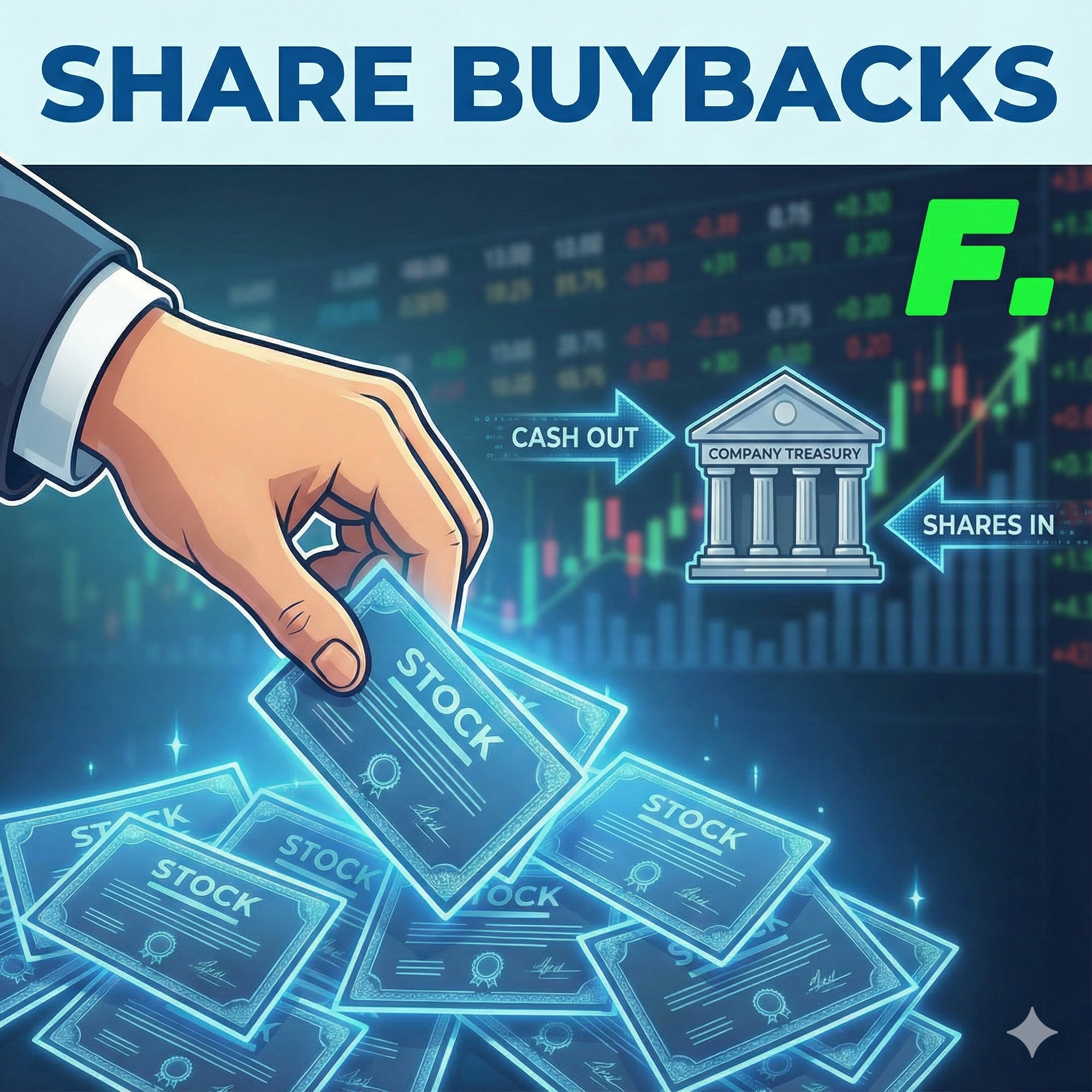
A share buyback is simply Arthur using the cash from the till to buy those tickets back from the villagers. It is like a baker buying back slices of a cake they already sold so they can own more of what is left. Once Arthur executes share buybacks, he takes the tickets back and throws them in the fire. Now, instead of 100 tickets floating around the village, there might only be 80. It is a neat trick that makes the remaining ticket holders feel like they own a bigger piece of the shop without Arthur actually baking a single extra loaf of bread.
How companies execute share buybacks
A company cannot just go to a store and buy stock. They have a few specific ways to handle share buybacks, and some are more aggressive than others. In our village bakery, Arthur has to decide how he is going to approach the neighbours to get those tickets back.
Buying on the open market
This is the most common way to handle share buybacks. Arthur just hangs around the village square. Every time he sees someone looking to get rid of their ticket, he offers to buy it at the going rate. He does this bit by bit over several months. He has to follow certain rules so he does not accidentally cause a panic or drive the price up too fast, but it is mostly a quiet process. It is great for the bakery because Arthur can stop these share buybacks whenever the flour prices go up or if the roof starts leaking and he suddenly needs that cash. It is the corporate version of shopping for your own birthday presents using the company credit card.
The big public offer for share buybacks
Sometimes a company wants to do massive share buybacks all at once. Arthur might stand on a crate in the middle of the square and shout that he is willing to buy 20 tickets right now for five pounds more than they are worth. He gives everyone a deadline to decide. This is faster than hanging around the square, but it is also more expensive because he has to tempt people to sell. It is essentially the company begging you to leave and throwing money at you to make it happen.
Private deals and share buybacks
Every now and then, Arthur might have a quiet word with the wealthiest person in the village who happens to own a massive pile of tickets. Maybe this person is starting to complain about the quality of the buns or asking too many questions about Arthur’s long lunch breaks. Arthur offers to buy their entire stack of tickets in one go, just to get them out of the way. These are backroom share buybacks designed to shut up a noisy investor who is making the bosses look bad.
The math behind share buybacks
The reason companies love share buybacks often comes down to the numbers on their report cards. By getting rid of some shares, they can make their financial health look better than it actually is. It is a bit like a student erasing their worst test scores to improve their average.
Boosting the earnings per share with share buybacks
Investors look closely at a number called Earnings Per Share or EPS. In the village, this is the amount of profit that belongs to each ticket. If The Golden Crust makes 100 pounds and there are 100 tickets, each ticket is worth 1 pound of profit.
If Arthur uses share buybacks to burn 20 tickets, he only has 80 left. Now that same 100 pounds of profit is divided by only 80 tickets. Suddenly, each ticket is worth 1.25 pounds in profit. Arthur did not actually sell more cakes, but on paper, the bakery looks like it is growing faster. Share buybacks are financial smoke and mirrors at their finest. It gives the illusion of a thriving business while the oven might actually be cold and the baker might be napping.
Improving the return on equity through share buybacks
There is another number called Return on Equity. This tells people how good Arthur is at using the money the villagers gave him. Share buybacks reduce the total amount of equity in the business because cash is leaving the bakery to pay off the ticket holders. When you have less equity but the same amount of profit, your return percentage goes up. It makes Arthur look like a genius manager, even if he is just playing a numbers game in the back office.
The king of share buybacks: Tim Cook and Apple
When you talk about people who have mastered share buybacks, you have to talk about Tim Cook. While Steve Jobs was the visionary who built the products, Tim Cook has proven to be a famous balance sheet alchemist. He realised that you do not always need to invent a brilliant new gadget to make the stock price go up. Sometimes you just need to set fire to a pile of cash to buy back the old shares.
For years, Apple has sat on a mountain of cash that is bigger than the economies of some countries. Instead of just letting that money sit in a bank account, Tim Cook decided to launch the biggest share buybacks programme in history. Since he took over, Apple has spent hundreds of billions of pounds on share buybacks.
By doing this, he has reduced the number of Apple shares by a massive amount. This means that even in years where Apple’s growth slowed down, the EPS kept going up because there were fewer shares to divide the profits by. It is a huge reason why the stock price has stayed so strong. He essentially turned Apple into a giant machine that produces cash and then uses that cash for share buybacks to make its own shares more scarce. While the fans wait for a new invention, the shareholders are just happy that Tim is busy manipulating the supply of the stock. He is the head baker who realised that if he keeps doing share buybacks, nobody will notice that the scones are exactly the same as last year.
What are share buybacks trying to tell us?
Share buybacks are a way for a company to talk to the world without using words. When a chief executive starts a programme of share buybacks, they are usually sending a few hidden messages, though you have to be careful not to fall for the gossip in the village square.
The first message is that they think their stock is a bargain. By spending the company cash on share buybacks, they are saying that the market is wrong about the price. It is like Arthur buying his own tickets because he knows they are worth more than five pounds. Of course, he might just be trying to trick you into thinking the tickets are a deal when the bakery is actually full of mice.
The second message is that the company is healthy. You cannot afford share buybacks if you are broke. It tells everyone that the bakery has plenty of cash and is not worried about the next flour shortage.
The third message is about being a good partner. It shows that the company wants to reward the people who stay by making their shares more valuable through these share buybacks.
The problems with share buybacks
Not everyone thinks share buybacks are a good idea. There are some real downsides that people worry about, and some of them are pretty ugly.
One big worry is that companies are being lazy with their share buybacks. Critics say that instead of buying back stock, Arthur should be using that money to invent a new type of pastry or pay his staff a living wage. When a company spends all its cash on share buybacks, it is often a quiet admission that they have run out of good ideas. They are basically saying we have no clue how to grow this bakery, so we will just do share buybacks instead.
Another problem is bad timing. Companies are famous for doing share buybacks when the price is at an all-time high because that is when they have the most cash in the till. Then, when the economy gets bad and the stock price drops, they stop the share buybacks because they are scared. This is the opposite of what a smart investor should do. It is essentially burning money at the top of the market while the bakery roof starts to sag and the villagers are hungry.
The bonus trap and share buybacks
We also have to look at how the bosses get paid. This is where share buybacks get really cynical. Many chief executives get huge bonuses if the EPS hits a certain goal. If Arthur realises he is not going to hit that goal by actually selling more bread, he might just start share buybacks to shrink the number of tickets. This hits the goal and gets him his gold watch, but it does not actually help the bakery in the long run. It is a legal way for a boss to use share buybacks to loot the company for their own benefit while the villagers cheer.
Companies also give out a lot of stock to their employees. If they did not do share buybacks, the number of tickets in the village would keep growing every year. This is called dilution. Many companies use share buybacks just to keep the share count steady so the existing owners do not feel their influence slipping away. It is a treadmill that costs the company billions in share buybacks just to stay in the same place.
Borrowing money for share buybacks
Lately, we have seen companies do something even riskier. Because interest rates were very low for a long time, companies borrowed billions of pounds just to fund their share buybacks. This is like Arthur taking out a massive loan to buy back tickets while he is still paying for the oven. It works as long as the bakery is busy, but if people stop buying bread, he is stuck with a massive debt. These debt-funded share buybacks are a high-stakes gamble that leaves the company much more fragile.
Share buybacks vs. dividends
When a company wants to give money back to its owners, it usually chooses between share buybacks and a dividend. A dividend is just a cash payment. Arthur gives everyone with a ticket 50 pence. The downside is that the tax man takes a bite of that 50 pence immediately.
Share buybacks are different. Instead of giving you cash, they make your ticket represent a bigger piece of the bakery. You do not have to pay any taxes until you decide to sell your ticket years later. This is why many long-term investors prefer share buybacks over dividends. It is a way to tell the government to go away for a while.
Also, a company can stop share buybacks whenever they want. If Arthur stops giving out the 50 pence dividend, the villagers will get angry and the ticket price will crash. Share buybacks give the management more freedom to change their mind without a total meltdown in the village square.
The tax man comes calling for share buybacks
Governments have recently started to get a bit annoyed with the sheer volume of share buybacks happening. In the United States, there is now a 1 per cent tax on the value of these share buybacks. The idea is to make it a little less attractive for companies to just pump their stock price and encourage them to spend more on things like worker pay or new ovens. While 1 per cent is not a huge deal, it shows that politicians are starting to view share buybacks as a bit of a scam that needs to be reined in.
Frequently asked questions about share buybacks
What is the definition of a share buyback?
A share buyback occurs when a public company uses its own cash or borrowed funds to purchase its shares from the open market or directly from shareholders. This process reduces the number of outstanding shares.
Why do companies engage in share buybacks?
Companies do share buybacks to return excess cash to shareholders, signal that the stock is undervalued, offset dilution from employee stock options, or improve financial metrics like Earnings Per Share and Return on Equity.
How do share buybacks affect earnings per share or EPS?
By reducing the total number of shares outstanding, the company profit is divided among fewer shares. This mathematically increases the EPS even if the actual net profit of the company stays the same.
Are share buybacks better than a dividend?
Share buybacks are often considered more tax efficient for shareholders because they defer tax liability until the shares are sold. Dividends are taxed immediately. Share buybacks also offer management more flexibility as they can be stopped or started without the negative stigma associated with cutting a dividend.
What are the main criticisms of share buybacks?
Critics argue that share buybacks promote short term thinking and that the money would be better spent on research, higher worker wages, or long term capital investments. There is also concern that executives use share buybacks to trigger performance bonuses tied to share price or earnings targets.
Who is famous for using share buybacks successfully?
Tim Cook of Apple is widely regarded as a master of share buybacks. Under his leadership, Apple has repurchased hundreds of billions of dollars worth of its own stock, significantly boosting its share price and earnings metrics over the last decade.
Are share buybacks taxed?
In many jurisdictions, there is a growing trend toward taxing share buybacks. For example, the United States recently implemented a 1 per cent excise tax on the total value of shares repurchased by public companies.
Can a company borrow money to fund share buybacks?
Yes, this is known as a debt funded share buyback. Companies often do this when interest rates are low, allowing them to replace expensive equity with cheaper debt, although this increases the risk on the company balance sheet.
Final thoughts on share buybacks
A share buyback is just a tool in a big corporate toolbox. If a company is doing well and has extra cash, share buybacks can be a smart way to help the owners. It is a sign of strength and confidence.
But share buybacks can also be used to hide problems. If Arthur is borrowing too much money or ignoring the cracks in his bakery walls just to pump up the ticket price with share buybacks, it usually ends badly. As an investor, you have to look past the headline and see why the company is doing share buybacks. You have to figure out if they are building something for the future like Apple or just putting on a show for the village while the bosses run off with the cash.