
How to Find the Best Stock to Buy Long Term: A Strategic Blueprint
If you are searching for the best stock to buy long term and you have landed on this article, it is probably because you do not have a solid process yet. You are likely looking at what everyone else is saying to try and figure out your next move.
Like most investors today, you are probably lost in a sea of information. You are being bombarded by contradictory hot tips on social media, dense financial reports, and the non-stop noise of the 24-hour news cycle.
Without a repeatable system, you are essentially gambling on someone else’s opinion rather than following your own strategy.
Finding the best stock to buy over the long term is not about chasing the latest headline.
It is about you spotting the massive shifts in the global economy and putting your money into the highest-quality companies that are already winning.
To find your best stock, you need a methodology.
This article breaks down how you can build a portfolio by picking impactful themes and then running them through a strict quality-momentum filter.
Why Most Investors Fail to Find the Best Stock to Buy Long Term
Before you look for the winners, you have to understand why so many people lose. Statistics consistently show a massive performance gap: while the S&P 500 might return around 10% annually over twenty years, the average retail investor often walks away with less than half of that.
The Small-Cap Trap
One of the biggest reasons for this underperformance is your potential obsession with small-cap or micro-cap stocks. You might be drawn to these because you want to find the next big thing that will go up 1,000% overnight. If you do this, you are treating the stock market like a lottery rather than a business.
The reality is that small caps are rarely the best stock to buy long term because they are often structurally lower quality. They are more sensitive to economic downturns, carry higher debt loads, and lack the massive cash reserves that industry leaders use to crush their competition. When you buy a low-quality small cap without a process, you are not investing.
You are hoping for a miracle.
The Behavioural Gap
The second reason investors fail is due to a misunderstanding of how emotions drive decisions. Many people buy when they feel confident, but for the average investor, that confidence is often just a reaction to noise or a late-stage price spike. Without a system, you are prone to the buy-high, sell-low cycle that destroys wealth.
However, you should not confuse emotional chasing with momentum. While buying at a 52-week high might feel like buying at the top, your methodology shows that these levels often represent a breakout into new territory.
The difference is clinical…
An emotional investor buys because they are afraid of missing out, whereas you buy because the price action confirms that the company is winning. A methodology allows you to use these highs as a signal for strength rather than a reason to be afraid.
Part 1: Your Core Pillars (Thematic Allocation)
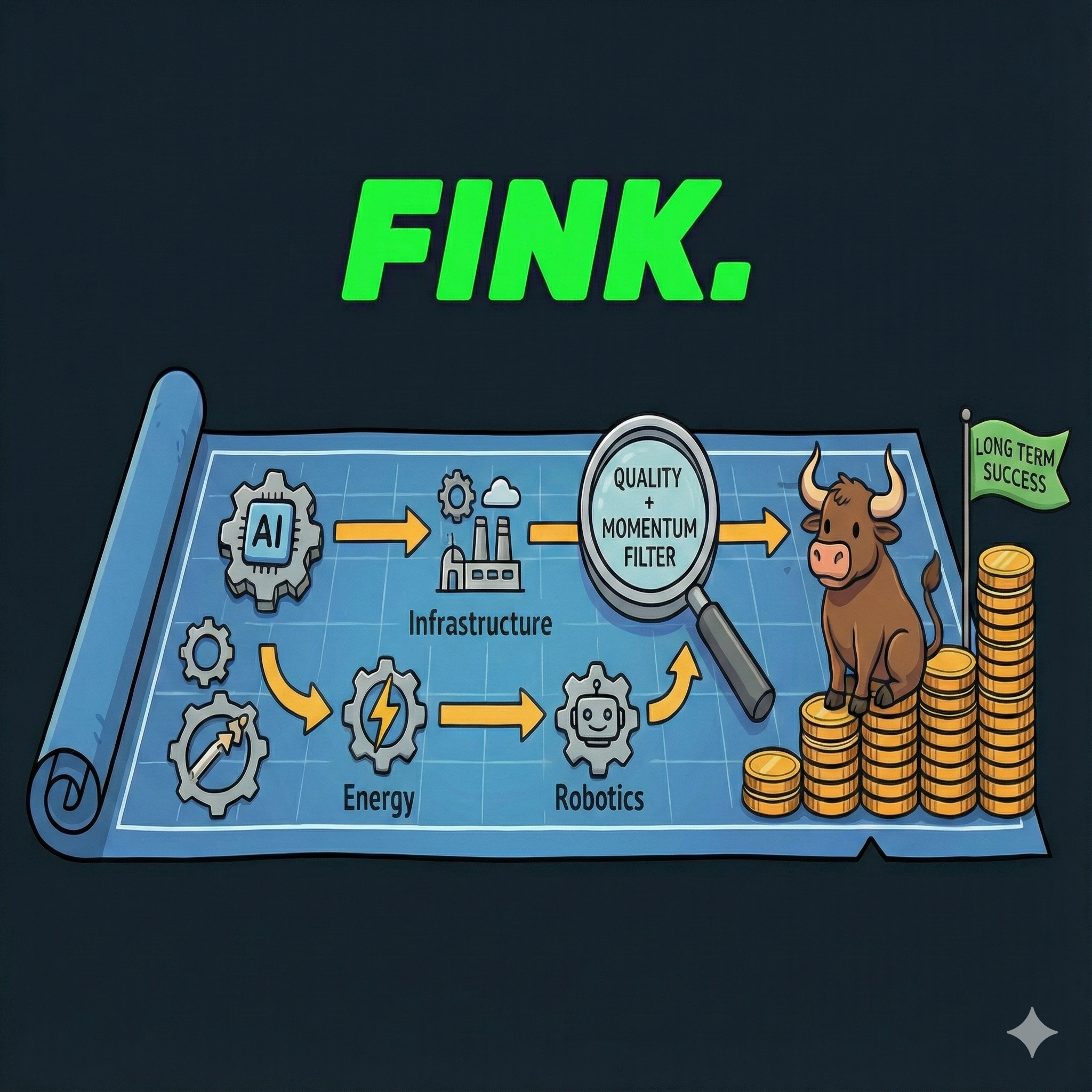
To identify the best stock to buy long term, you should build a solid portfolio on themes that have decades of growth ahead of them. While you might have your own specific views on where the world is heading, these are the four themes I like the most right now because they represent massive, structural shifts for you to capitalise on:
1. Artificial Intelligence (AI)
Think of this as the Intel Inside of the next industrial revolution. AI is not just a speculative bet anymore: it has become a basic requirement for your productivity.
- Your focus: Look past the big names like Microsoft or Google and focus on the companies making it happen: custom silicon (ASICs), high-speed networking, and data centre optimisation.
2. Infrastructure
Physical infrastructure is the picks and shovels of the digital age. You need to realise that without the power grid and the cooling systems, all that code simply does not run.
- Your focus: Data centre electrical systems, liquid cooling, and the physical building of sovereign AI clouds.
3. Energy
The AI boom has transformed energy back into a growth sector for you. You will see that data centres need constant power that traditional renewables cannot always handle alone.
- Your focus: Nuclear energy (SMRs), modernising the grid, and high-efficiency power transmission.
4. Robotics
As labour costs go up and populations get older, you will see that automating everything is becoming a necessity.
- Your focus: Humanoid robots, surgical automation, and autonomous logistics.
Part 2: Your Filtering System (Quality + Momentum)
Once you have picked your sectors, you need a way to find the single best stock to buy long term in each one. You should use two specific factors that, when you put them together, give you a real edge.
Factor 1: Quality (Your Anchor)
Quality is what protects you when things get messy. You want high-quality companies with moats that help them survive when the economy takes a dip.
But high quality does not mean boring or that it lacks volatility.
What you should look for:
- Return on invested capital (ROIC): You should look for high and consistent returns. This tells you the company is brilliant at turning its money into profit and is outperforming its competitors.
- Free cash flow (FCF) margin: You want a company that generates plenty of cash so it can pay for its own growth without needing you to worry about expensive debt.
- Low debt-to-equity: With interest rates staying higher for longer, you cannot ignore a strong balance sheet.
Factor 2: Momentum (Your Engine)
Momentum is the simple idea that things going up tend to keep going up. It shows you that the market is finally waking up to how successful a company is.
- Relative strength: You want the stock to be beating its peers and the main indexes like the FTSE 100 or S&P 500 over the last 6 to 12 months.
- 52-week highs: When you see stocks trading near their all-time highs, they usually have the least resistance standing in their way.
- Earnings momentum: You want to see analysts constantly bumping up their profit estimates for the company you are watching.
Part 3: Your Execution (Applying the Filter)
To find your best stock to buy long term, you have to find the spot where quality and momentum meet within your themes.
| Theme | Industry | How You Apply the Filter |
| AI | Custom Silicon | Quality: High margins and unique tech. Momentum: Beating the broader chip index. |
| Infrastructure | Thermal Management | Quality: Essential parts with high switching costs. Momentum: Massive order backlogs. |
| Energy | Nuclear/Grid | Quality: Reliable or contracted cash flows. Momentum: Strong support from government policy. |
| Robotics | Precision Components | Quality: Very hard for competitors to start making. Momentum: Moving into brand new industries. |
Your Alpha Strategy: Rebalancing
Every six months, you should run your filters again. If a stock you hold starts losing its quality or its momentum fades away, it is no longer the best. When that happens, you swap it out for the new leader in that sector.
Common Questions on Long-Term Investing
Is it better to diversify across many stocks or concentrate on the best?
If you spread your capital too thin, you end up with mediocre returns. Diversification is often a hedge for people who do not have a process. By focusing on the best stock to buy long term in each of your core themes, you concentrate your wealth in the highest-quality winners. You only need a handful of leaders to outperform the market.
What happens if a quality stock starts dropping in price?
This is where your rebalancing comes in. You must distinguish between a temporary market dip and a loss of momentum. If the company still has a high ROIC and strong cash flow, but the stock is underperforming its peers for months on end, the market is telling you something is wrong. You do not hold on for sentimental reasons; you follow the data.
How do I know if a theme is overhyped?
A theme is overhyped when the prices are rising but the quality metrics are not. If you see companies in a sector with no free cash flow and negative returns on capital trading at massive valuations, that is a bubble. However, if the companies are making record profits and growing their moats, the trend is real.
Should I wait for a market crash to buy?
Waiting for a crash is a form of market timing that rarely works for retail investors. The best stock to buy long term often stays expensive for years because it is a leader. Your momentum filter ensures you are buying strength. If you wait for a crash, you might miss a 100% gain while waiting for a 20% discount.
Your Mindset as a Long-Term Winner
Forget about the one-off lucky trades. Identifying the best stock to buy long term is a relentless, clinical process.
By locking into high-impact themes and only backing companies that deliver world-class quality paired with undeniable market momentum, you stop guessing and start winning. This methodology ensures you take a stake in a dominant industry leader exactly when the market begins rewarding their success.
However, keep in mind that this framework is just a small part of the overall picture. If you want to stop guessing and start building your wealth systematically, the Fink Academy is the best place to go.
If you are ready to take this seriously, you can book a call here to discuss how to professionalise your approach.