
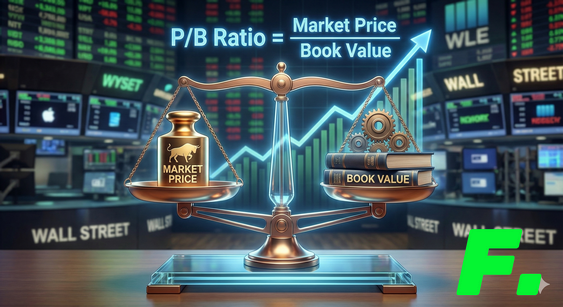
In this three-part series, I’m going to explain how the Price-to-Book (P/B) ratio is actually a secret weapon for understanding value in a changing interest rate environment.
Let’s be honest: most people treat investing like a game of chance.
They buy a stock because it’s trending, or because an influencer told them it’s a “sure thing.”
Meanwhile, savvy investors use something more nuanced to understand the market: financial ratios.
These aren’t just numbers on a screen; they are the keys to understanding whether a company is overpriced, underpriced, or just plain risky.
We are breaking down killer ratio insights with no maths degree required (it’s basic maths that some people love to overcomplicate for no reason).
Price-to-Book (P/B) Ratio Relief
Everyone talks about how lower interest rates push up share prices, but there’s another side to the story that almost nobody mentions.
When rates drop, companies can refinance their debt at lower rates. This instantly improves their balance sheets and makes their assets more valuable.
The result? Book values start to climb, sometimes even faster than share prices.
The Price-to-Book (P/B) ratio is simply the share price divided by the book value per share.

Most investors assume that when share prices go up, the P/B ratio must rise too.
But if the book value is increasing at the same time, the ratio can actually stay flat or even dip.
This provides “short-term relief” for the valuation, even during a market rally.
I recently used AI to analyse GoDaddy’s share price:
A key takeaway was how they hedged 79% of their variable rate debt out to 2027.
This strategy immediately increased their book value relative to their peers because their liabilities remained lower while others struggled with rising costs.
This is exactly why the Price-to-Book (P/B) ratio is so powerful when contextualized with debt.
What This Means for the S&P 500 (SPX)
Currently, the S&P 500’s Price-to-Book (P/B) ratio is sitting at a multi-decade high.

However, this is happening while interest rates are still relatively high.
If we see aggressive rate cuts, the book value of these companies will likely rise as refinancing becomes easier and asset values (like property and loans) increase.
For sectors like Banks and Real Estate (REITs), this is a double win:
- Banks: Lower rates make loan books more profitable and balance sheets stronger
- REITs: Lower rates push up property values and make refinancing old debt a breeze
“When rates fall, the SPX Price-to-Book (P/B) ratio could dramatically drop in the short term, even if prices stay the same.
This recalibrates value-sensitive investors who might have been waiting on the sidelines to jump back in.”
The Bottom Line: Watch the Balance Sheet
If you want to stay ahead of the crowd, keep an eye on book value as well as share price, especially when rates are on the move.
Most investors only focus on the “Price” side of the Price-to-Book (P/B) ratio, but the real action is happening on the balance sheet.
In our Academy, we teach specific models for managing your portfolio using these ratios. They are incredibly powerful when used right.
Part Two drops tomorrow! We’re going to get even more practical and look at the Price-to-Sales (P/S) ratio to see how revenue growth fits into this story.